Evangelical Church A. B.
Brașov
Building History
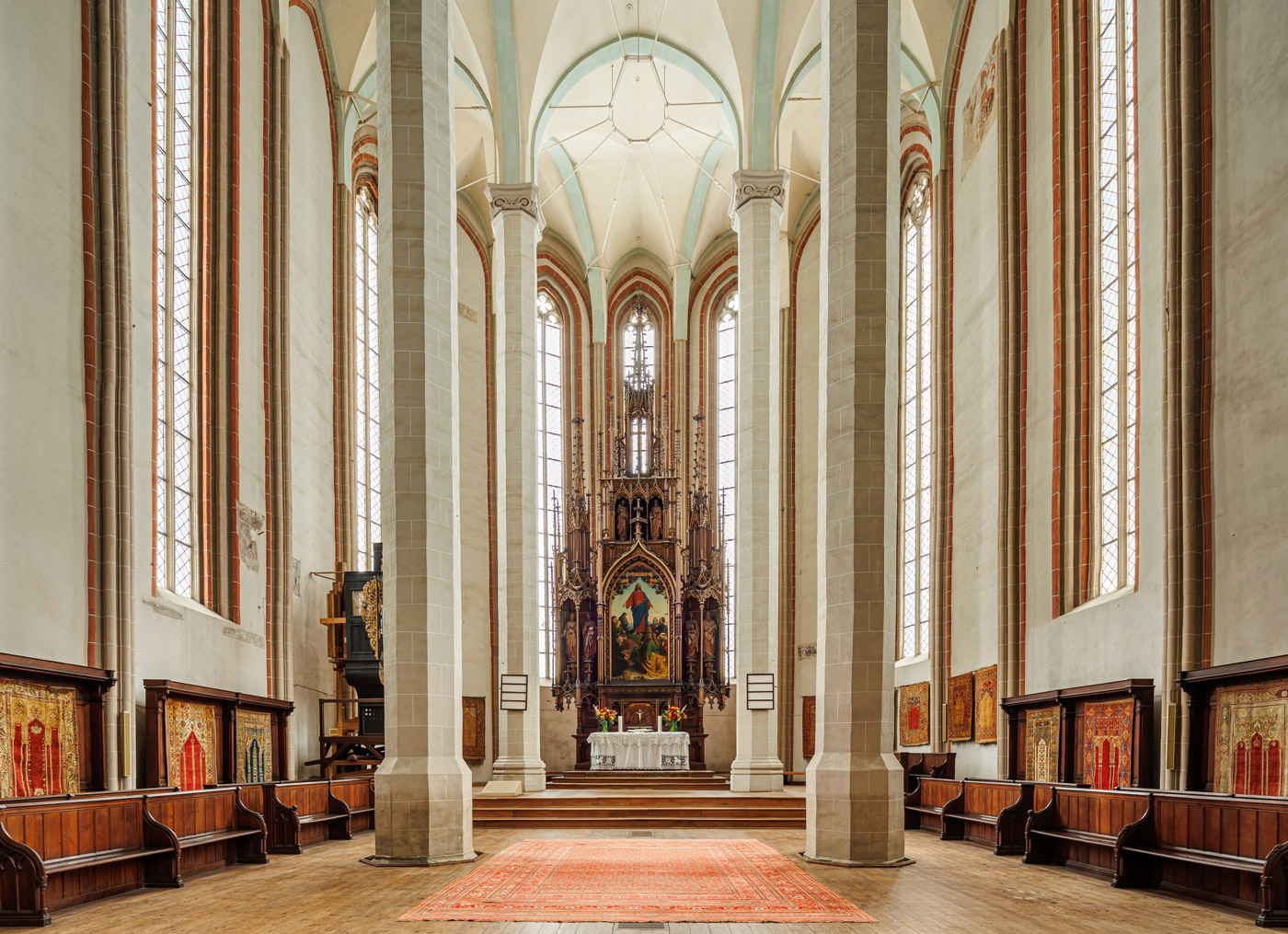
As early as the High Middle Ages, around 1200, nuns of the Premonstratensian Order arrived from the Lower Rhine region in the valley below the Zinne. A monastery church was built approximately on the site where the Black Church stands today, and its foundations have been archaeologically documented. Settlers also established themselves in the vicinity of the monastery. They, too, had come from German-speaking regions in the west and developed, not only here but also in other parts of Transylvania, into a legal community with its own identity and culture: the Transylvanian Saxons. After the monastery had ceased to exist, the predominantly Transylvanian Saxon population of Brașov converted the monastery church into a parish church. Around 1380, construction began on a much larger, three-aisled hall church on the site of the old parish church. The impressive hall choir closely follows the model of the Sebaldus Choir in Nuremberg, while the nave must have been built with the involvement of a building lodge that had already worked on St Elizabeth’s Church in Kaschau. In the course of the introduction of the Reformation in the early 1540s, the Roman Catholic Church of St Mary was converted into a Protestant town parish church. As the Reformation, following the Wittenberg model, proceeded in a moderate manner and there were no outbreaks of iconoclasm, the church retained much of its pre-Reformation furnishings even after the Reformation. It was not until the great town fire of 21 April 1689 that the church lost its roof, vaults and the greater part of its furnishings. Reconstruction took almost ninety years. It began with the installation of a new roof, included the construction of Baroque-Gothic side galleries and culminated in the construction of new vaults in the choir and nave. Two interventions in the nineteenth century continue to shape the interior to this day: the installation of the large organ by Carl August Buchholz, an organ builder from Berlin, and the refurnishing of the choir with Neo-Gothic choir stalls and a remarkable Neo-Gothic altar.
The name ‘Black Church’, coined around the turn of the nineteenth to the twentieth century for the Evangelical Town Parish Church of the Augsburg Confession in Brașov, derives from the darkening of its façades caused by increasing air pollution in the valley basin as a result of industrialisation. The heating system installed in 1937 can be regarded as a remarkable industrial monument of Romania. Today, the Black Church is one of Romania’s best-known architectural monuments and the landmark of the city of Brașov.
Prevention History
While the maintenance of the church building, supported by the local congregation, had already suffered a considerable loss of resources as a result of the declining significance of the German population of Transylvania between the late eighteenth and late nineteenth centuries, its continuity was not seriously disrupted until the Second World War and the dramatic decline in membership figures. Despite the subsequent precarious material conditions in communist Romania, major restoration works, which had already been initiated at the beginning of the twentieth century, were completed in the early 1990s, drawing on the technological methods available at the time, many of which are often regarded as problematic from today’s perspective. Following the fall of the Iron Curtain, large waves of emigration led to a further decline in membership. On the other hand, the reconstruction of parish administrative structures was also achieved.
Since 2015, the congregation has been endeavouring to catch up with the latest technological and methodological developments in heritage conservation and to establish an infrastructure which, in the legal form of a foundation, ensures the professional and continuous maintenance of the church building. Since March 2026, the Evangelical Church of the Augsburg Confession in Brașov has been a member of the European Association of Cathedral Works Departments, Minster Works Departments and Master Builders’ Lodges. It hopes to use the exchange of experience to assess the advantages of establishing a permanent building site, as opposed to the current practice at the Black Church of commissioning specialists for limited periods, with whose assistance problems can only be resolved on an ad hoc basis. One of the tasks of the specialists to be recruited will be to bring modern heritage conservation methods into line with the established Romanian legislation governing the protection of historic monuments.
Fotos © Evangelische Kirche A. B. Kronstadt, Béla Benedek
Contact
Evangelical Church A. B. • Curtea Johannes Honterus nr. 2 • 500025 Brașov • Romania
+40 (0) 268 511 824
honterusgemeinde.ro/kulturerbe/stiftung-bauhuette/